
In any busy commercial kitchen, dishwashing is more than just a chore; it’s a measure of operational efficiency, hygiene, and throughput. Without the right option, you could face service disruptions, foodborne illness, or increased labor costs.
Whether you’re running a small café or a high-volume cafeteria, choosing the right dish machine type helps your staff keep pace with service demands while maintaining high sanitation standards.
In this article, we’ll break the three main dish machine types down and explore the comparisons, trade-offs, and requirements of each. By the end, you should have a good idea of which kind best fits your operation’s needs.
Let’s get started!
How This Guide Evaluates Dish Machines
Before we get into the different machine types, it’s helpful to understand the key performance areas used throughout this article. These categories offer an apples-to-apples comparison so decision makers can more easily understand the tradeoffs of each machine.
Footprint and Design Considerations
This includes physical space requirements, configuration flexibility, clearance, and the best installation environment for each machine. It also accounts for workflow layout, ventilation needs, and how the operator interacts with the machine.
Cleaning Capacity and Throughput
How many racks per hour can the machine handle? Does it support continuous loading? What types of dishes is it optimized to clean? This category covers these and also considers how well the machine keeps up during peak rush periods.
Water, Chemical, and Energy Efficiency
Each type of dish machine uses different amounts of water per cycle or per rack. This section evaluates consumption levels, heat recovery features, energy-efficient design elements, and long-term operational costs.
Ease of Installation and Maintenance
Every machine requires some level of setup and upkeep. This category covers how easy the machine is to install, routine maintenance tasks, common points of failure, accessibility to internal components, expected equipment life, and considerations for long-term ownership.
Cost
A commercial dish machine is a long-term investment. This section covers not only the upfront cost to purchase, but also what you can expect to pay over the life of your investment to run, maintain, and repair the machine.
Best Use Cases
To help you quickly identify which machine may be best for your facility, each machine type ends with a summary of the environments and volume levels it is best suited for.
What are the Different Types of Commercial Dish Machines?
- Undercounter Dish Machines
- Upright (door-type) Dish Machines
- Conveyor Dish Machines
1. Undercounter Dish Machines
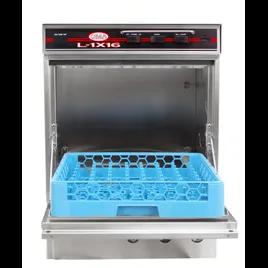
Undercounter commercial dish machines are the smallest and most compact variety. They are about the same size as a household dishwasher and can tuck neatly beneath standard kitchen countertops in either the back-of-house (BOH) or front-of-house (FOH).
They cycle much faster than a residential dishwasher, making them ideal for small kitchens, bars, cafés, or any operation where space is at a premium.

Footprint and Design Considerations
Because of their compact size, undercounter dish machines typically can be installed under a standard 36” counter. Their footprint typically ranges from 23” to 25” wide and deep, allowing them to easily slot into existing cabinetry with minimal disruption.
Most are front-loading units with a simple pull-down door, similar to a residential dishwasher but built with higher-grade materials and equipped with more robust washing power. Because these machines are tightly enclosed, they tend to emit less noise and heat than other types of machines.
Their low-profile design makes them well suited for open-concept prep areas or venues where the dishwashing station is close to guests.
Cleaning Capacity and Throughput
An undercounter machine can typically wash between 20 and 40 racks per hour, depending on cycle length. Their typical cycle length ranges from 90-180 seconds per rack.
This capacity is best suited for small operations with predictable, low-to-moderate volume. For comparison, an upright dish machine can process two to three times as many racks per hour.
Undercounter models are designed to handle standard dishware, flatware, and small utensils. However, they can struggle with large cookware or full-size sheet pans unless your machine is specifically designed for higher clearance.
Water, Chemical, and Energy Efficiency
Modern undercounter machines often feature relatively lower water usage, around 0.6 to 0.8 gallons per rack. Energy Star-rated models can reduce operating costs further by using efficient rinse heaters, insulated wash chambers, and optimized spray patterns.
Because these units are smaller, they also typically require lower chemical dosing levels compared to larger dish machines, making them more budget-friendly in the short-term or for lower volume operations.
Ease of Installation and Maintenance
Undercounter dish machines are relatively easy to install, often requiring only a 120-208V electrical connection, a hot water supply, and a floor drain or direct drain connection. They also tend to have fewer mechanical components than conveyor or upright units, which can simplify maintenance.
Some routine maintenance tasks include:
- Cleaning wash arms
- Emptying scrap trays
- Descaling build-up
- Checking chemical feed lines
These tasks are quick and manageable for most staff, with minimal training required.
Cost
Undercounter dish machines are the most budget-friendly commercial dish machine type. Most models range from $3,000 to $7,000 depending on whether they are high-temp or low-temp, include built-in booster heaters, or offer specialty features like ventless operation.
Installation costs are relatively low because these units are designed to tie directly into existing undercounter plumbing and standard electrical circuits. Some high-temp units may require upgraded power or their own dedicated circuit.
Operational costs are modest due to low water consumption, minimal electrical demand, and less chemical use, however, their low volume capacity can make them a less effective option over time. Because each cycle must be started manually and operators have to wait for racks to finish before reloading, the cost per rack rapidly increases as volume increases.
Annual operating costs, including energy, water, chemical, and routine maintenance, typically range from $800 to $2,000. Expect a 7-10 year lifespan.
Best Use Cases
Undercounter dish machines are ideal in:
- Small restaurants
- Bars and breweries
- Coffee shops
- Office kitchens
- Satellite prep stations
They’re perfect for when space is restricted and where dish volume stays low and consistent.
2. Upright (Door-Type) Dish Machines
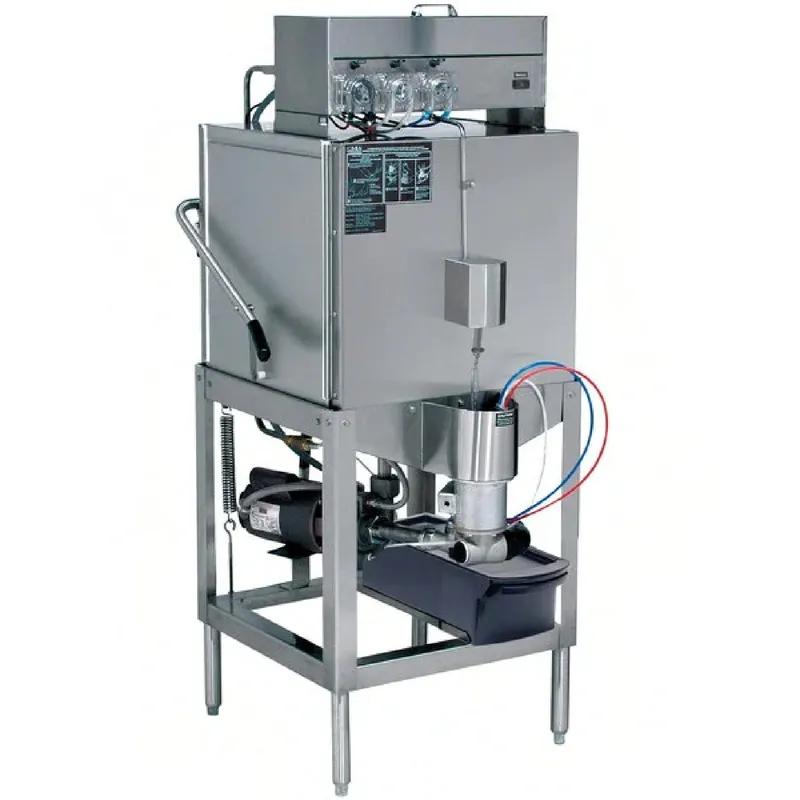
Also referred to as “pass-through” or “hood” dishwashers, upright machines feature a front (or side) door or a hood that slides up and down. Staff loads a rack manually, then when they close the door, the wash cycle automatically starts.

These machines are a staple in many medium-volume kitchens because they offer greater capacity than an undercounter unit, with a smaller footprint than conveyor systems.
Footprint and Design Considerations
Upright dishwashers require more vertical space than undercounter models. Their vertical footprint allows your staff to wash pots, pans, cooking sheets, and other large or irregularly shaped items.
While their dimensions can vary widely, many units are around 25” wide and 25” deep, plus table extensions on one or both sides, and with heights ranging from 60” to 90”.
In terms of workflow, these machines are most often placed between a dirty dish table and a clean landing zone, creating a linear process for scraping, loading, and unloading.
Ventilation and steam management may be necessary depending on your model and facility layout.
Cleaning Capacity and Throughput
Upright machines commonly handle between 40 and 75 racks per hour, with some hyper-efficient models reaching as high as 100 racks per hour. Their typical cycle length ranges from 60-120 seconds per rack. Some models have longer cycles, as much as six minutes, for heavier loads.
This capacity is best suited for medium volume operations. While they aren’t as fast as conveyors, upright machines handle heavy meal rushes well and offer the flexibility to run various ware types without needing to be adjusted.
Water, Chemical, and Energy Efficiency
Door-type machines use roughly 0.8 to 1.4 gallons of water per rack. Many modern models include energy-saving features such as heat recovery systems, ventless condensers, or low-flow wash arms.
High-temp units typically require more electrical infrastructure but can significantly improve sanitation and drying time.
Because they can handle more dishes in the same rinse volume, they are almost always more efficient per rack than undercounter machines.
Ease of Installation and Maintenance
Installation requires more space and utilities than undercounter machines. Low-temperature units use 115V electrical connections, while high-temperature units need a 208V 3Ph or 240V 1Ph electrical connection and their own dedicated circuit. They also often require a booster heater to meet high-temperature sanitation standards.
Although their larger mechanical systems tend to require more upkeep than undercounter units, they are still relatively simple to maintain.
Some routine maintenance tasks include:
- Deliming
- Wash arm cleaning
- Checking thermostats
- Making sure the hood mechanism operates smoothly
With proper care, these machines tend to be durable and can operate for many years, even in high-demand environments.
Cost
Upright dish machines are at a mid-range price point. Most models range from $8,000 to $15,000, with advanced ventless or heat-recovery models reaching $16,000 to $20,000.
Installation requires dedicated electrical circuits and stainless steel inlet and outlet tables, adding another $1,500 to $5,000 depending on layout.
From an operational efficiency standpoint, upright machines offer a compelling ROI for most mid-volume kitchens. Because they are significantly more efficient than undercounter units and can be loaded and uploaded at waist height, fatigue is reduced and workflow is improved, often by as much as 30-50% in labor time because racks move through quickly.
Annual operating costs range from $1,500 to $3,500 depending on utility rates and cycle volume, but over a 10-12 year lifespan and with labor savings factored in, upright machines consistently outperform smaller and even some larger systems in ROI.
Best Use Cases
Upright dish machines are ideal for:
- Full-service restaurants
- School cafeterias
- Hotels
- Banquet venues
- Caterers (especially with fluctuating dish volumes)
They strike the best balance between footprint and throughput.
3. Conveyor Dish Machines
Conveyor dish machines are built for scale. These machines use a motorized conveyor to move racks of dishes quickly through multiple zones: pre-wash, main wash, rinse, and final sanitizing. Some models include integrated drying zones as well for even faster turnaround.
These are the workhorses of high-volume operations like large cafeterias, hospitals, and institutional kitchens.
Footprint and Design Considerations
Conveyor systems take up significant floor space. Not only do you need room for the machine itself, you also need a loading area and an unloading area.
These dish systems can require 100 square feet of floor space or more, depending on conveyor length and the space needed for staff to operate comfortably.
You may also need to install significant infrastructure: large drains, dedicated booster heaters, venting or hood systems, and possibly water-recycling or heat-recovery mechanisms.
Cleaning Capacity and Throughput
Conveyor dish machines offer the highest throughput of the three main types. Conservatively, you can expect these models to handle 150-200 racks per hour, or even higher depending on the specific setup and number of tanks.
Because the conveyor runs consistently (or at least semi-continuously), throughput is much less dependent on worker loading speed once the system is properly balanced. Dishes enter on one end and exit clean at the other, allowing constant throughput without the need to stop and swap racks.
Water, Chemical, and Energy Efficiency

While conveyor machines naturally require more resources due to their size, modern units have become surprisingly efficient. Many only use 0.45 to 0.6 gallons per rack thanks to their advanced spray patterns and recycling systems.
Some of their energy-efficient features include heat recovery units, insulated tanks, variable-speed motors and automatic tank fill and dump cycles.
Because they run continuously, heating systems often require substantial electrical or gas supply.
Chemical use is higher as well, but is also optimized for large-scale operations.
Ease of Installation and Maintenance
Installation is significantly more complex and often requires:
- Multiple electrical connections
- Large, dedicated floor drains
- Ventilation and heat recovery systems
- Proper tabling and workflow design
Maintenance is also drastically more intensive due to the number of moving parts and the scale of operation. However, these machines are engineered for durability and continuous use.
Daily cleaning includes:
- Wash arm cleaning
- Tank draining
- Belt cleaning
- Internal inspection
Preventative maintenance is essential with these types of machines to avoid breakdowns that can bottleneck entire foodservice operations.
Cost
Conveyor dish machines are a major investment, with base models priced between $20,000 and $40,000. High-end or multi-tank configurations, as well as flight-type machines, can reach as high as $75,000 to $120,000.
Installation costs are substantial due to the electrical requirements, steam management, floor drains, stainless steel tabling, water filtration systems, and occasional HVAC modifications. You can expect total installation and setup to add another $10,000-$30,000, depending on the dishroom buildout and complexity.
Despite the high upfront price, conveyor machines offer the greatest per-rack efficiency. They often reduce labor because of their continuous workflow, and their water and chemical consumption per rack is optimized and surprisingly low.
Annual operating costs can vary widely, but typically land between $4,000 to $10,000. These costs are driven by energy use, chemical supply, and preventative service. You can expect a 12-20 year lifespan on conveyor dish machines.
These machines reward staying on top of maintenance to avoid costly breakdowns.
Best Use Cases
Upright dish machines are ideal for:
- Hospitals
- Universities
- Large hotels, resorts, and casinos
- Stadiums
- Correctional facilities
- Food courts
- Large banquet halls
If hundreds or thousands of meals are served per day, conveyor systems offer unmatched speed and efficiency.
Final Thoughts
Choosing the right commercial dish machine is a strategic decision that influences labor, utility costs, layout, and long-term efficiency. By understanding the strengths and trade-offs of undercounter, upright (door-type), and conveyor machines, you can align your warewashing setup with your operation’s volume, space, and financial goals.
Undercounter units excel in compact environments with quick, small loads.
Upright (door-type) machines strike a balance between capacity, efficiency, and versatility.
Conveyor systems are designed for scale and automation, and are ideal for continuous, high-volume operations.
In addition to capacity and footprint, also consider the sanitation method, energy efficiency, maintenance demands, and compliance with regulatory standards. The right machine does more than clean dishes; it optimizes your workflow.
By carefully evaluating your needs against these key criteria, you can choose a commercial dish machine that makes sense now and scales for the future.
Still not sure which model is the best for you? Reach out to your local Imperial Dade expert for a free consultation! We can help you find the right fit for your workflow, environment, and budget.
Check Out These Related Articles:
- How to Fix a Commercial Dishwasher That Won’t Drain
- How to Fix a Leaking Commercial Dishwasher: Step-by-Step Guide
- Commercial Dishwasher Troubleshooting: A Guide to Dish Machine Repairs
- Why is My Dishwasher Leaving Dishes Dirty? 5 Common Reasons & How to Fix
- How to Clean a Commercial Dishwasher: 3 Expert Tips
- Commercial Dishwasher Not Cleaning Dishes? Here’s the fix!
- How to Choose the Right Commercial Dish Machine for Your Business
- The Secret to Getting Clean Wares From Your Commercial Dishwashing Machine (3 Key Elements)